Sites › Africa › Great Sphinx of Giza
Great Sphinx of Giza
| Location | Giza Plateau, west bank of the Nile, Greater Cairo, Egypt |
|---|---|
| Conventional date | Fourth Dynasty, reign of Khafre, about 2500 BCE (carved from bedrock within his pyramid complex). |
| Alternative date proposals | |
| What is measured |
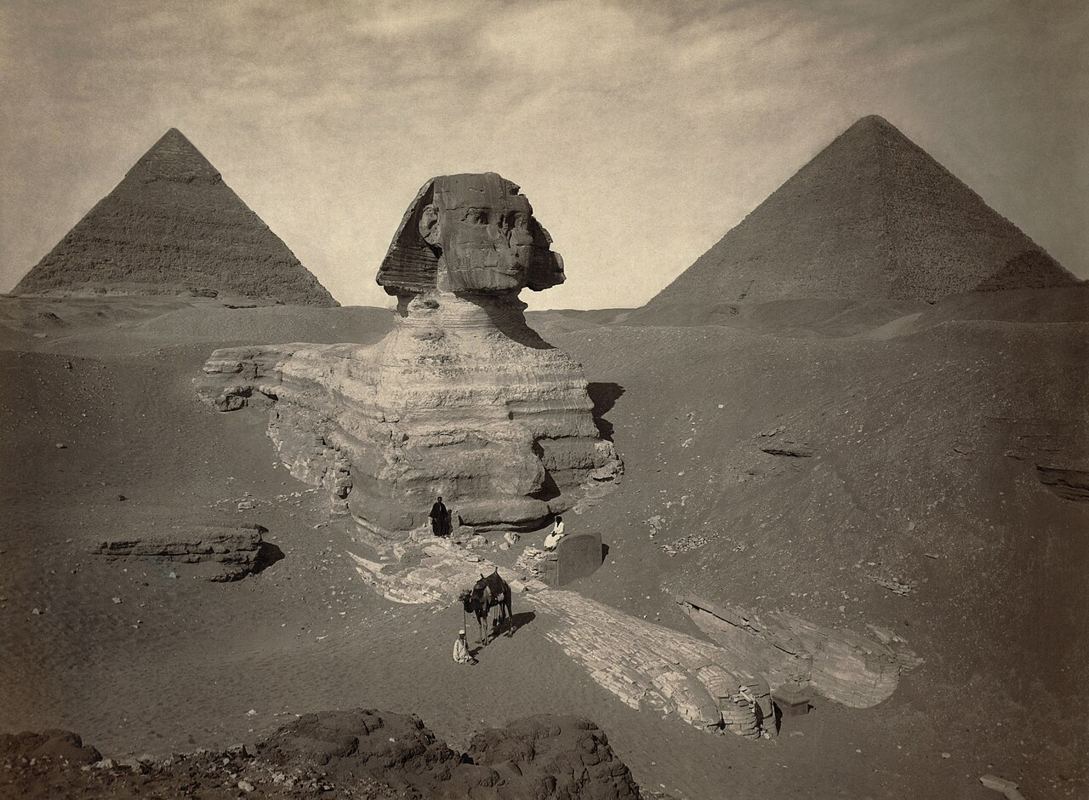
The Sphinx is about 73 m long and was carved from the plateau's layered limestone, so the stone itself cannot be dated by the usual methods. The age question rests on geology (weathering), context (its place in Khafre's complex) and the absence or presence of older material culture. The historic photograph on this page shows it still partly buried in sand, which is relevant to the wet-sand weathering argument.
Claims about this site
| Claim | Status | Verdict |
|---|---|---|
| The Great Sphinx is thousands of years older than Egyptologists think (water-erosion hypothesis) | Leading Edge | Open question |
| The Sphinx faced Leo rising at the spring equinox around 10,500 BCE | Leading Edge | Measured sky: Leo rose before the equinox Sun at Giza from about 11,400 to 8,800 BCE, so 10,500 BCE fits; whether the Sphinx was built for this, and when, is an open question |
| Radiocarbon dates from Giza mortar fall in the Old Kingdom era, with an unresolved offset | Mainstream | Measured: mortar charcoal dates to c. 2900–2600 BCE; the cause of a 100–400-year offset is still debated |
| The Fourth Dynasty completed an older Giza site (the 'legacy' or restoration hypothesis) | Leading Edge | Open question: the built pyramids date to the Old Kingdom; no dating method has yet reached the bedrock and underground parts |
| An advanced civilisation existed during the last Ice Age and was lost in a catastrophe | Leading Edge | Open question |
Visiting: Giza pyramids and Sphinx
Affiliate links: the links below go to tour searches on GetYourGuide and Viator. If you book through them, Truth in Stone may earn a commission at no extra cost to you. We don't run or vet these tours; check reviews, cancellation terms and current travel advice from your government before booking. Commissions never affect our evidence labels. Affiliate disclosure.
- Giza pyramids & Sphinx tours (search) GetYourGuide
- Giza pyramids & Sphinx tours (search) Viator
Sources
- Schoch, R. M. The Great Sphinx (author's own summary of his water-erosion dating, with links to his 1992 KMT paper). https://www.robertschoch.com/sphinx.html proponent
- Dobecki, T. L. & Schoch, R. M. (1992). Seismic investigations in the vicinity of the Great Sphinx of Giza, Egypt. Geoarchaeology 7(6). doi:10.1002/gea.3340070603 data
- Harrell, J. A. (1994). The Sphinx controversy: another look at the geological evidence. KMT 5(2) (online reprint). http://www.hallofmaat.com/sphinx/the-sphinx-controversy-another-look-… critique
- Lal Gauri, K., Sinai, J. J. & Bandyopadhyay, J. K. (1995). Geologic weathering and its implications on the age of the Sphinx. Geoarchaeology 10(2). doi:10.1002/gea.3340100203 critique
- Reader, C. D. (2001). A geomorphological study of the Giza necropolis, with implications for the development of the site. Archaeometry 43(1). doi:10.1111/1475-4754.00009 proponent
- Reader, C. D. (2026). Rewriting the History of the Great Sphinx. Archaeopress (January 2026). doi:10.2307/jj.38271388 proponent
- Lacovara, P. (2026). Review of Rewriting the History of the Great Sphinx. American Journal of Archaeology (October 2026). doi:10.1086/744239 critique
- Sheisha, H. et al. (2022). Nile waterscapes facilitated the construction of the Giza pyramids during the 3rd millennium BCE. PNAS 119. doi:10.1073/pnas.2202530119 data
Dates are summarised in our own words from the sources listed. Conventional and alternative dates are both reported; "measured" lists only dated or documented findings. Methodology.