Claims › Egypt: Sphinx & Giza dating › The Sphinx faced Leo rising at the spring equinox around 10,500 BCE
The Sphinx faced Leo rising at the spring equinox around 10,500 BCE
The claim: The lion-bodied Great Sphinx faces due east, toward the spring-equinox sunrise. Around 10,500 BCE the constellation Leo, the lion, rose in that direction just before the equinox Sun, so the Sphinx was designed as a marker of that epoch.
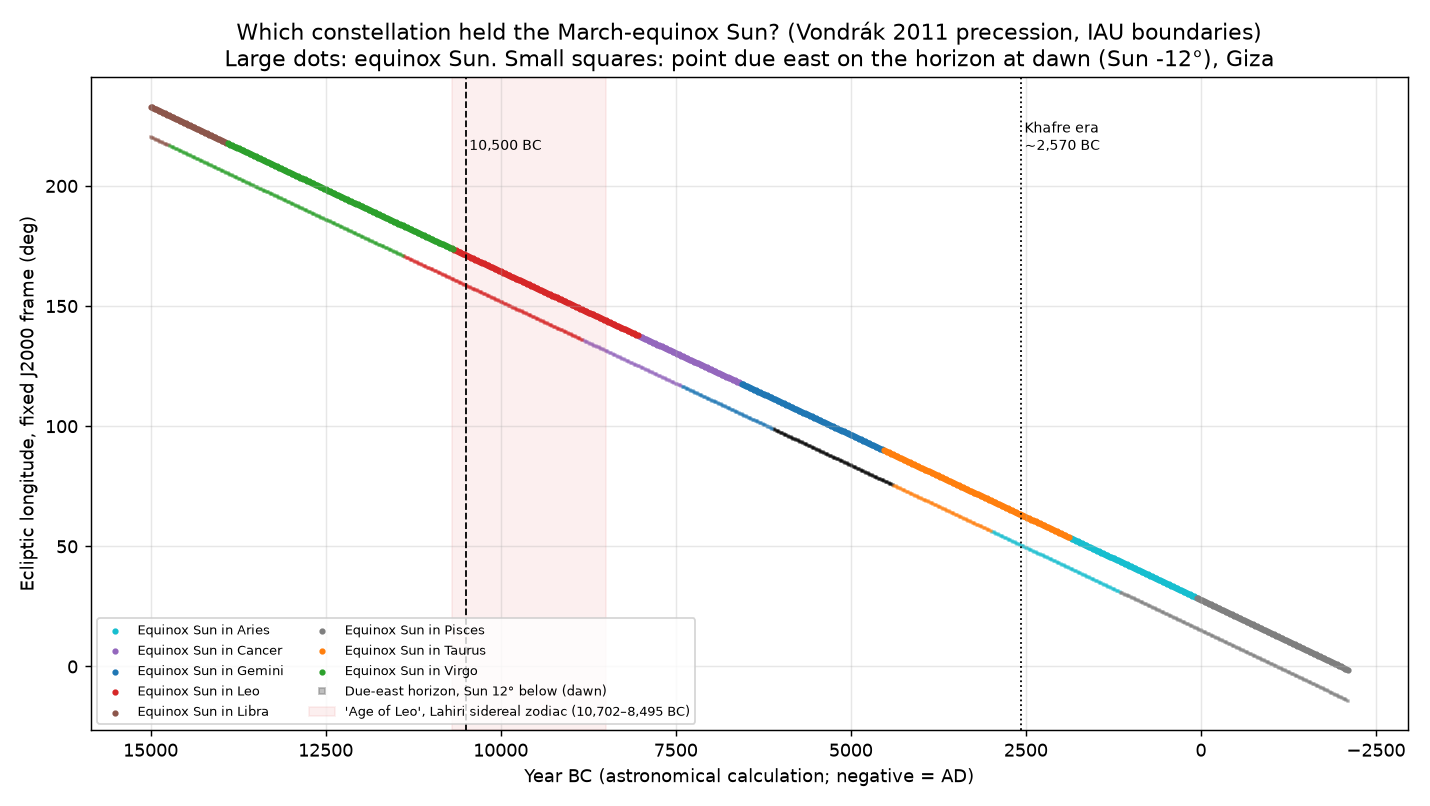
Where the evidence stands: The sky part can be computed. Using a modern long-term precession model and the official constellation boundaries, we find that Leo sat on Giza's due-east horizon before the equinox sunrise from about 11,400 to 8,800 BCE, so 10,500 BCE fits. That window spans more than 2,000 years, so the sky cannot pin a single date. Whether the builders intended a Leo alignment is a separate question: the zodiac's lion figure appears in Egyptian art only in the Ptolemaic period, and Egyptologists attribute the Sphinx to Khafre, about 2500 BCE, when Leo was far below the horizon at the equinox dawn.
Background
Robert Bauval and Graham Hancock proposed in Keeper of Genesis / The Message of the Sphinx (1996) that the Sphinx, a lion facing the equinox sunrise, points to the 'Age of Leo', when Leo rose ahead of the equinox Sun, and they dated this to about 10,500 BCE. Earlier critics, including the astronomer Tony Fairall in 1999, placed the 10,500 BCE equinox in neighbouring Virgo. We re-ran the sky with the long-term precession model of Vondrák, Capitaine and Wallace (2011), the official 1930 IAU constellation boundaries and SIMBAD star data. The results are our own computation and are summarised below with their caveats; the method and script are linked further down. They support the sky picture Bauval and Hancock describe, but over a window too wide to fix a date. Related: the Sphinx water-erosion claim, the Orion correlation, the legacy hypothesis and the Giza pyramids site page.
What has been measured
Dates, measurements and documented findings, kept separate from interpretation.
- Our computation: under the official IAU constellation boundaries, the March-equinox Sun lay inside Leo from about 10,660 to 8,030 BCE. In 10,500 BCE it was about 2° inside Leo, close to the Virgo border. [7][2][4]
- Our computation: at Giza, Leo occupied the due-east horizon on the equinox morning while the Sun was still 12° below the horizon (when bright stars are visible) from about 11,390 to 8,830 BCE. [7][2][6]
- Our computation: Regulus, Leo's brightest star, first became visible on the equinox morning around 10,900–10,540 BCE, depending on assumed viewing conditions. It rose about 10° south of due east. [7][6]
- Our computation: in Khafre's era (about 2500 BCE) the equinox Sun rose in Taurus, with Aries on the eastern horizon before dawn. Leo was far below the horizon. [7][2]
Method
How we computed this: precession follows the long-term model of Vondrák, Capitaine and Wallace (2011, with a 2012 corrigendum), as implemented in the IAU SOFA/ERFA library (pyerfa). Constellations use the official IAU 1930 boundaries as digitised by Roman (1987), via astropy. Star positions and motions come from SIMBAD. At the March equinox the Sun sits at the equinox point, so calendar dates are not needed. Giza is taken at latitude 29.98° N and the Sphinx as facing due east. Altitudes are geometric; haze and horizon effects can shift the star-visibility dates by about 150 years. These date ranges are our own computation, not taken from a published paper. Download the Python script (CC0 1.0, free to reuse).
Proponents' main arguments and cited evidence
- Bauval and Hancock argue that a lion-bodied monument gazing at the equinox sunrise was meant to mark the age when Leo rose ahead of the equinox Sun, which they date to about 10,500 BCE. [1]
- The Sphinx has a lion's body and faces due east, toward the sunrise at the equinoxes. [1][11]
- Our computation shows the sky matched this description in 10,500 BCE, and the first equinox-morning sighting of Regulus falls close to the date they proposed. [7][2]
The mainstream position and its evidence
- The zodiac, including the lion figure of Leo, appears in Egyptian art only in the Ptolemaic period; the best-known example, the Dendera zodiac, dates to about 50 BCE. Egypt's own earlier star figures were different. [9][10][8]
- The IAU boundaries were drawn in 1930. If an ancient 'Leo' was outlined differently, our dates shift by roughly 150–300 years (our estimate). [4][7]
- The window lasts more than 2,000 years, so the sky alone cannot single out 10,500 BCE; it is consistent with that date but does not prove it. [7]
- Fairall (1999) placed the 10,500 BCE equinox in Virgo. Our computation with the modern long-term precession model puts it just inside Leo; the difference most likely comes from assuming today's constant precession rate, though we did not check his exact method. [8][2]
- Egyptologists attribute the Sphinx to Khafre, about 2500 BCE, when no Leo alignment was possible. A monument facing due east faces the equinox sunrise in every era, so the orientation alone does not point to Leo. [11][12]
What evidence would help settle it
Evidence that people in the Nile Valley recognised a lion constellation in this part of the sky long before the Ptolemaic period would strengthen the reading. An independent date for the Sphinx's core body (see the water-erosion claim) would show whether it could have existed during the Leo window at all.
Sites
Great Sphinx of Giza · Giza pyramids
Related claims
Sources
- Hancock, G. & Bauval, R. (1996). Keeper of Genesis (UK) / The Message of the Sphinx (US). Heinemann / Crown. https://openlibrary.org/search?q=message+of+the+sphinx+hancock proponent
- Vondrák, J., Capitaine, N. & Wallace, P. (2011). New precession expressions, valid for long time intervals. Astronomy & Astrophysics 534: A22. doi:10.1051/0004-6361/201117274 data
- Vondrák, J., Capitaine, N. & Wallace, P. (2012). New precession expressions, valid for long time intervals (Corrigendum). Astronomy & Astrophysics. doi:10.1051/0004-6361/201117274e data
- Roman, N. G. (1987). Identification of a constellation from a position. Publications of the Astronomical Society of the Pacific 99: 695 (digitised IAU 1930 constellation boundaries). doi:10.1086/132034 data
- Astropy Project. astropy.coordinates.get_constellation (documentation): constellation lookup using the IAU 1930 boundaries. https://docs.astropy.org/en/stable/api/astropy.coordinates.get_conste… data
- SIMBAD astronomical database, CDS Strasbourg (star positions, proper motions, parallaxes and radial velocities; queried 22 October 2026). https://simbad.cds.unistra.fr/simbad/ data
- Truth in Stone (2026). Sphinx–Leo precession computation: Python script, released under CC0 1.0. /static/downloads/sphinx-leo-precession.py data
- Fairall, A. (1999). Precession and the layout of the ancient Egyptian pyramids. Astronomy & Geophysics 40(3). doi:10.1093/astrog/40.3.3.4 critique
- Krupp, E. C. (1997). Pyramid marketing schemes. Sky & Telescope, February 1997 (online reprint). https://www.hallofmaat.com/orioncorrelation/pyramid-marketing-schemes/ critique
- Musée du Louvre. Zodiaque de Dendéra (E 13482 / D 38), dated June–August 50 BCE (collection record). https://collections.louvre.fr/en/ark:/53355/cl010028871 background
- Lehner, M. (1997). The Complete Pyramids. Thames & Hudson. https://openlibrary.org/search?q=the+complete+pyramids+lehner critique
- Lehner, M. & Hawass, Z. (2017). Giza and the Pyramids. Thames & Hudson / University of Chicago Press. https://openlibrary.org/search?q=giza+and+the+pyramids+lehner critique
More in this section: Egypt: Sphinx & Giza dating.
Sources checked against Crossref and publisher pages on 2026-10-22. This entry presents a debated idea neutrally: the proponents' case first, then the mainstream position, in our own words. "Open question" is not a judgment that the idea is true or false. Labels describe the claim, not the people who hold it. Methodology.