Sites › Africa › Giza pyramids
Giza pyramids
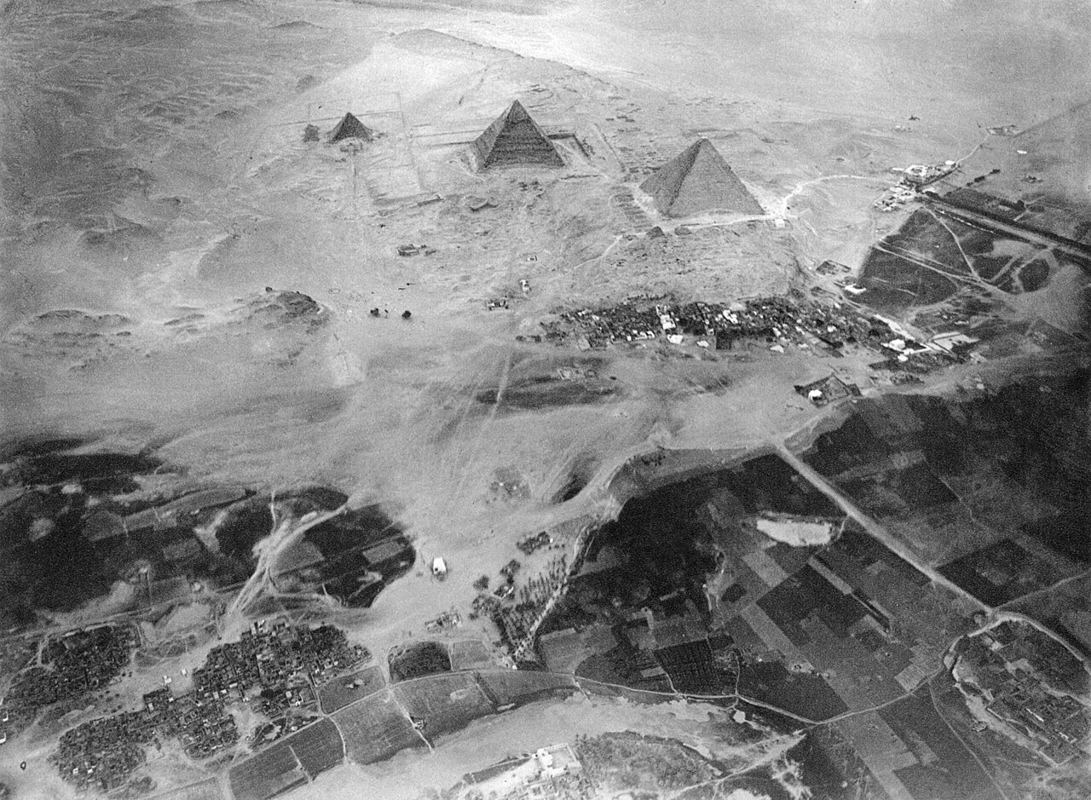
| Location | Giza Plateau, Greater Cairo, Egypt |
|---|---|
| Conventional date | Fourth Dynasty, about 2600–2500 BCE (Khufu, Khafre, Menkaure). |
| Alternative date proposals |
|
| What is measured |
|
The Great Pyramid was the tallest human-made structure for thousands of years. Evidence for Fourth Dynasty construction includes radiocarbon dates on mortar and the reconstructed Nile branches that carried building material to the plateau. Open questions include construction methods and the purpose of the newly found internal spaces.
Claims about this site
| Claim | Status | Verdict |
|---|---|---|
| The Great Sphinx is thousands of years older than Egyptologists think (water-erosion hypothesis) | Leading Edge | Open question |
| The Sphinx faced Leo rising at the spring equinox around 10,500 BCE | Leading Edge | Measured sky: Leo rose before the equinox Sun at Giza from about 11,400 to 8,800 BCE, so 10,500 BCE fits; whether the Sphinx was built for this, and when, is an open question |
| Radiocarbon dates from Giza mortar fall in the Old Kingdom era, with an unresolved offset | Mainstream | Measured: mortar charcoal dates to c. 2900–2600 BCE; the cause of a 100–400-year offset is still debated |
| The Giza pyramids mirror Orion's Belt as it looked in 10,500 BCE (Orion Correlation) | Leading Edge | Open question: the shape match tests as statistically notable; the 10,500 BCE date is not supported by the layout's angle |
| The Fourth Dynasty completed an older Giza site (the 'legacy' or restoration hypothesis) | Leading Edge | Open question: the built pyramids date to the Old Kingdom; no dating method has yet reached the bedrock and underground parts |
| The Great Pyramid's precision and its 1:43,200 scale model of the Earth | Leading Edge | Measured: aligned within about 4 arc minutes and within about 1% of Earth's proportions at 1:43,200; whether the scale is intentional is an open question |
| Hidden spaces inside the Great Pyramid detected by cosmic-ray muons | Mainstream | Measured: two unknown voids confirmed |
| Satellite radar reveals vast structures beneath the Khafre pyramid | Leading Edge | Open question: unverified; the method's 2022 paper was retracted in Aug 2026 |
| Pyramids around the world point to a common lost source | Leading Edge | Open question |
Visiting: Giza pyramids and Sphinx
Affiliate links: the links below go to tour searches on GetYourGuide and Viator. If you book through them, Truth in Stone may earn a commission at no extra cost to you. We don't run or vet these tours; check reviews, cancellation terms and current travel advice from your government before booking. Commissions never affect our evidence labels. Affiliate disclosure.
- Giza pyramids & Sphinx tours (search) GetYourGuide
- Giza pyramids & Sphinx tours (search) Viator
Sources
- Bonani, G. et al. (2001). Radiocarbon dates of Old and Middle Kingdom monuments in Egypt. Radiocarbon 43(3). doi:10.1017/s0033822200038558 data
- Dee, M. W. et al. (2009). Reanalysis of the chronological discrepancies obtained by the Old and Middle Kingdom Monuments Project. Radiocarbon 51(3). doi:10.1017/s0033822200034111 data
- Bronk Ramsey, C. et al. (2010). Radiocarbon-based chronology for dynastic Egypt. Science 328. doi:10.1126/science.1189395 data
- Morishima, K. et al. (2017). Discovery of a big void in Khufu's Pyramid by observation of cosmic-ray muons. Nature 552. doi:10.1038/nature24647 data
- Procureur, S. et al. (2023). Precise characterization of a corridor-shaped structure in Khufu's Pyramid by observation of cosmic-ray muons. Nature Communications 14. doi:10.1038/s41467-023-36351-0 data
- Ghoneim, E. et al. (2024). The Egyptian pyramid chain was built along the now abandoned Ahramat Nile Branch. Communications Earth & Environment 5. doi:10.1038/s43247-024-01379-7 data
- Sheisha, H. et al. (2022). Nile waterscapes facilitated the construction of the Giza pyramids during the 3rd millennium BCE. PNAS 119. doi:10.1073/pnas.2202530119 data
- Remote Sensing editors (10 Aug 2026). Retraction notice for Biondi & Malanga 2022: 'serious methodological flaws and statistical errors'; the authors disagree. doi:10.3390/rs18162679 notice
- National Geographic (2025). Is there really a secret city under Egypt's Giza pyramids? (reporting on the March 2025 Khafre claims and expert responses). https://www.nationalgeographic.com/history/article/is-there-a-secret-… background
- Members of the David H. Koch Pyramids Radiocarbon Project (1999). Dating the Pyramids. Archaeology 52(5). https://archive.archaeology.org/9909/abstracts/pyramids.html data
- Tallet, P. (2017). Les papyrus de la mer Rouge I: le 'journal de Merer' (MIFAO 136). IFAO, Cairo (publisher's summary). https://www.ifao.egnet.net/uploads/publications/divers/MIFAO136_ann_01.pdf data
- Dash, G. & Paulson, J. (2016). The 2015 survey of the base of the Great Pyramid. Journal of Egyptian Archaeology 102. doi:10.1177/030751331610200114 data
- Peet, P. (2016). New claims about the Great Pyramid, citing the oldest papyrus ever found (includes an emailed statement from Graham Hancock). grahamhancock.com, 29 September 2016. https://grahamhancock.com/peetp1/ proponent
- Robert Schoch on The Joe Rogan Experience #1124 (2018), transcript. https://jre.ai/episodes/1124-robert-schoch/transcript proponent
- Bauval, R. & Gilbert, A. (1994). The Orion Mystery. Heinemann. https://openlibrary.org/search?q=the+orion+mystery+bauval proponent
- Allan, E. (2026). A comprehensive statistical evaluation of the Orion–Giza correlation. Journal of Astronomical History and Heritage 29(2): 367–378. doi:10.3724/sp.j.1440-2807.2026.02.06 data
Dates are summarised in our own words from the sources listed. Conventional and alternative dates are both reported; "measured" lists only dated or documented findings. Methodology.