Sites › Asia › Göbekli Tepe
Göbekli Tepe
| Location | Near Şanlıurfa, south-east Türkiye, Türkiye |
|---|---|
| Conventional date | Pre-Pottery Neolithic, enclosures from about 9500 BCE. |
| Alternative date proposals | |
| What is measured |
|
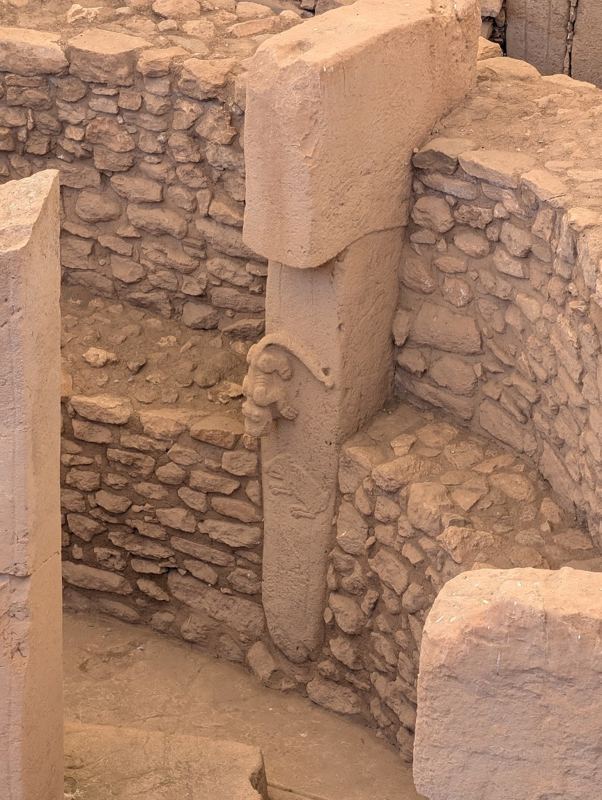
Monumental enclosures of carved T-pillars built by hunter-gatherers soon after the Younger Dryas ended. UNESCO World Heritage Site. The image shows a carved pillar relief.
Claims about this site
| Claim | Status | Verdict |
|---|---|---|
| Göbekli Tepe's megalithic enclosures are about 11,600 years old | Mainstream | Measured: c. 9500 BCE |
| Göbekli Tepe's Vulture Stone records a comet impact and an ancient calendar | Leading Edge | Open question |
| An abrupt cold snap, the Younger Dryas, hit about 12,900 years ago | Mainstream | Measured: c. 12,900–11,700 years ago |
| A comet impact or airbursts triggered the Younger Dryas about 12,800 years ago | Contested | Open question; several key papers retracted 2025–26 |
| An advanced civilisation existed during the last Ice Age and was lost in a catastrophe | Leading Edge | Open question |
| Earth suffers a recurring catastrophe about every 12,000 years | Leading Edge | Open question |
Visiting: Göbekli Tepe and Şanlıurfa
Affiliate links: the links below go to tour searches on GetYourGuide and Viator. If you book through them, Truth in Stone may earn a commission at no extra cost to you. We don't run or vet these tours; check reviews, cancellation terms and current travel advice from your government before booking. Commissions never affect our evidence labels. Affiliate disclosure.
- Göbekli Tepe & Karahan Tepe tours (search) GetYourGuide
- Göbekli Tepe tours (search) Viator
Sources
- German Archaeological Institute (DAI) blog: How old is it? Dating Göbekli Tepe. https://www.dainst.org/en/blogs/how-old-is-it-dating-goebekli-tepe/625 data
- Dietrich, O. et al. (2013). Establishing a radiocarbon sequence for Göbekli Tepe: state of research and new data. Neo-Lithics 1/13 (PDF). https://jensnotroff.com/wp-content/uploads/2015/10/ii-13_15_neolithic… data
- Sweatman, M. B. & Tsikritsis, D. (2017). Decoding Göbekli Tepe with archaeoastronomy: what does the fox say? Mediterranean Archaeology and Archaeometry 17(1). https://www.research.ed.ac.uk/en/publications/decoding-gobekli-tepe-w… proponent
- Notroff, J., Dietrich, O. et al. (2017). More than a vulture: a response to Sweatman and Tsikritsis. Mediterranean Archaeology and Archaeometry 17(2). doi:10.5281/zenodo.599855 critique
- Sweatman, M. B. (2024). Representations of calendars and time at Göbekli Tepe and Karahan Tepe support an astronomical interpretation of their symbolism. Time and Mind 17. doi:10.1080/1751696X.2024.2373876 proponent
Dates are summarised in our own words from the sources listed. Conventional and alternative dates are both reported; "measured" lists only dated or documented findings. Methodology.